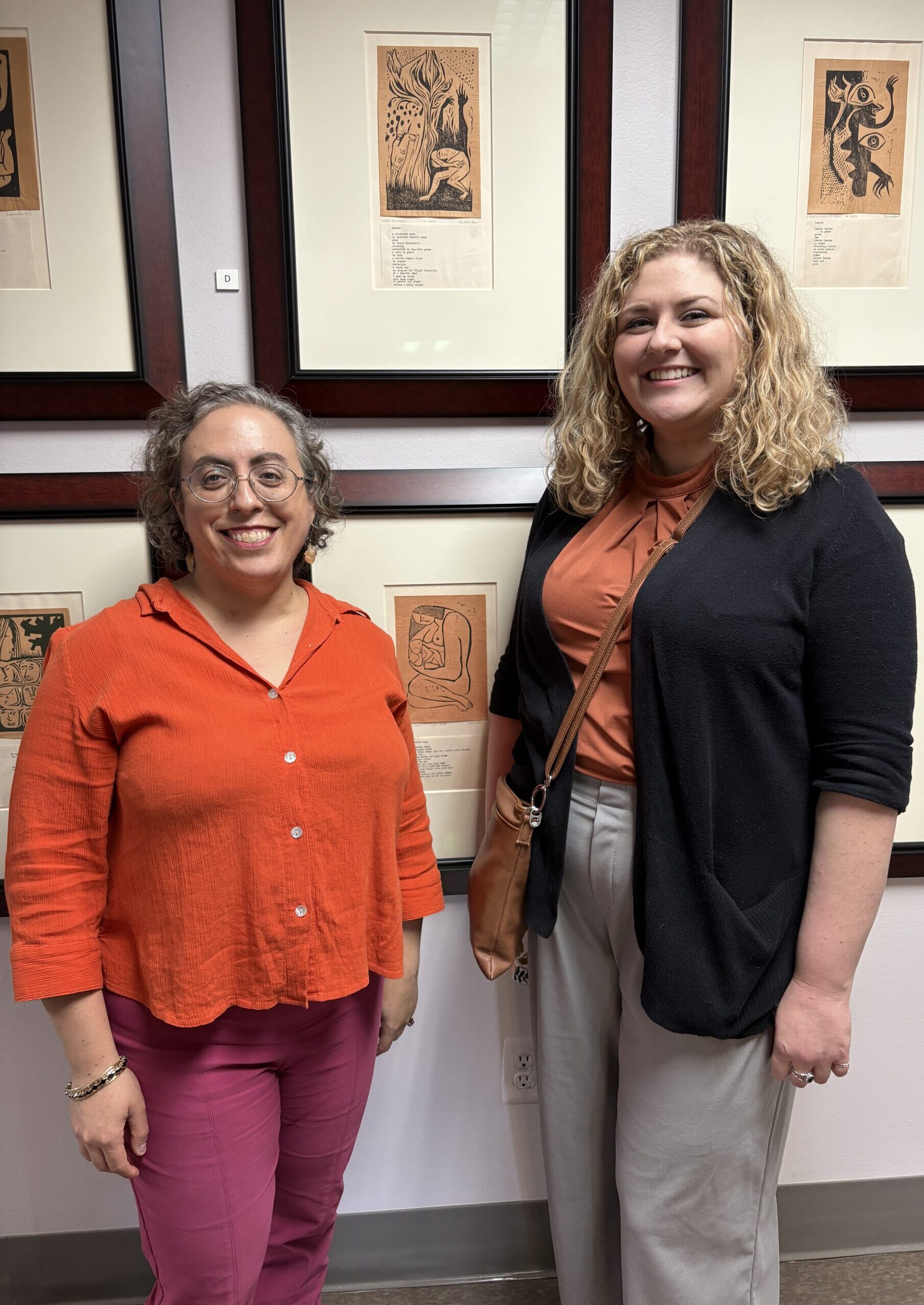
Cleary University Professor and Award-Winning Poet Justine Defever recently incorporated Cleary’s Arthur Secunda Museum into her Creative Writing class in a unique way, joined by Curator Suzanne Fischer.
Defever taught students about ekphrastic poetry, a form of writing that uses words to describe, respond to, or interpret a work of visual art, such as a painting, sculpture, or photograph.
During the lesson, Fischer led students on a tour of the Secunda Museum, sharing insight into his work. Students then had time to walk around on their own and find a piece that spoke to them. After taking notes and photos they returned to the classroom, and left with an assignment to write a poem based on a piece. Defever says the lesson gave students an opportunity to learn more about the artwork they pass by every day on their way to class in the Chrysler Building.
“They really enjoyed it,” Defever says. “They enjoyed learning about the pieces and the back stories behind them.”
Defever has extensive experience with ekprastic poetry. In 2022, she won third place in “Art Talks Back,” a contest that invites Michigan writers to enter an original ekphrastic poem based on a work of art in the Muskegon Museum of Art’s permanent collection. Defever also served as a poetry juror for the 9th annual Poetic Visions of Mackinac art and poetry exhibition, held this summer at Mission Point Resort’s Center for the Arts.
“It’s one of my personal favorite genres of poetry to write,” she says. “And I thought ‘we’ve got this museum here, let’s connect it’.”
It’s the first year Cleary University has offered Creative Writing for dual enrollment and early college students, who are attending Cleary while still in high school, as well as traditional undergraduate students who can take the course as an elective. Defever says the lesson was successful and she plans to keep it in the curriculum for the class.
Early College Student Bella Hodge wrote about Secunda’s collage Peace Brother (Three Fingers), created in 1965.
“I chose to write about this piece because it was printed during a sad yet hopeful time in American history,” she says, imagining that Secunda dreamed of building a place of peace despite the turmoil of the era.
Communications Major Morgan Murphy picked a more modern piece for her poem — Genesis 8:11, a monotype depicting a dove, which Secunda created in 2006.
“I was drawn to how Arthur Secunda illustrated this symbol of a new beginning,” she says.
Read their poems and see the artwork that informed them here:
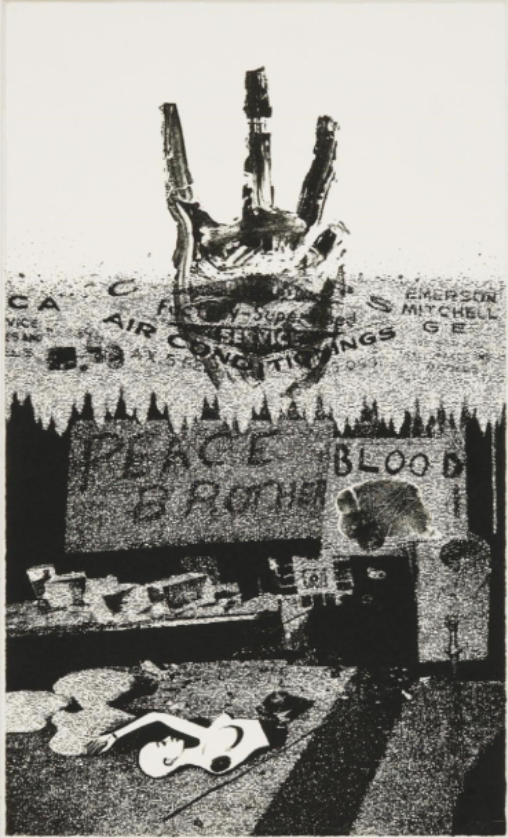
“Peace Fingers” a poem by Bella Hodge
After Peace Brother (Three Fingers) by Arthur Secunda (1965).
a hand from the smoke
two fingers reaching toward heaven,
one lagging behind—
a fractured peace between hope and ruin.
the air is thick with words
cut by machines and remembrance—
peace brother bleeding through
the cacophony of metal wings.
I catch a glimpse of the silence between the fingers,
how it trembles like a gasp
caught between forgiveness and fire.
perhaps Arthur saw it as well—
how peace can’t exist alone,
how it must grow
from what’s been devoured.
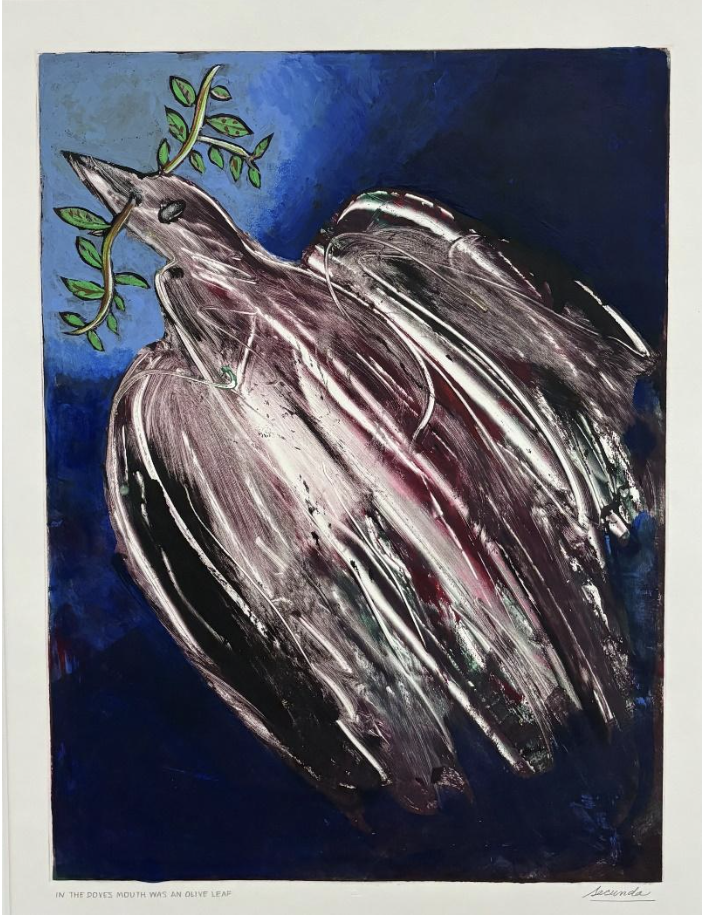
“Genesis’ Dove” a poem by Morgan Murphy
After Genesis 8:11 by Arthur Secunda (2006).
“When the dove returned to him in the evening, there in its beak was a freshly picked olive leaf!
Then Noah knew that the water had receded from the earth.”
The reflections of the earth great blues
The dove brought Noah an abundance of emotions.
Joy. Relief. Achievement.
The branch is from an olive tree holding hundreds of thousands more
of its own weight of graciousness.
Though, the perception bestowed upon us of a savior’s dove is more ethereal
Showing us this bird,
who only has strokes of pearl white
with shading of charcoal grey and hints of crimson throughout its body.
Looking as if the olive branch has become, one with the dove.
This wondrous portrait of what seems like a fable creature,
Yet, what is to be expected of a savior’s bird?
To learn more about the Arthur Secunda Museum at Cleary University, click here.